Showing posts with label Born Free USA. Show all posts

Friday, 11 March 2016

Translocation: a good first step away from deer-killing


by Barry Kent MacKay, Director
 
Late in February Liz White and I travelled to Kimberley, British Columbia, population 7600 (see https://en.wikipedia.org/wiki/Kimberley,_British_Columbia).  Liz and I were there to monitor a mule deer relocation project,  thanks to support from Born Free USA, Zoocheck and Animal Alliance of Canada.  Animal Alliance had contributed $10,000 to a project that involved moving mule deer out of town to carefully chosen distant habitats.  Those locations were chosen to maximize the chances the deer would have to survive.   The money Animal Alliance donated to the project bought collars equipped with radio-telemetry devices that report the location of the deer via a transmission to a satellite every 13 hours.  They are designed to eventually fall off but would provide enough information to allow the scientists to determine how successful the process was in terms of survival of the deer.

Mule deer in BC
Lest you think it odd that animal protection organizations such as ours would have even minimal involvement in such a thing let me assure you it was to provide part of an alternative to the current deer culling where deer are captured in “clover traps” and killed by a bolt gun.  Earlier this year someone captured this process during a secretly conducted cull in the nearby town of Cranbrook.  The BC Deer Protection society, (http://www.bcdeer.org/), of which both Liz and I are directors, posted the footage online.

Mule deer inhabit various towns and small cities that are built in close proximity to vast forests and the animals make use of both urban and wilderness habitats.  So they are more likely to come into direct contact with residents and given that mule deer are not as inclined to flee humans as are many other larger wildlife species, conflicts arise.  Often these conflicts involve dogs, many of whom are off-leash.  In the spring does will defend their fawns, occasionally escalating the conflict.  Other complaints include impacts on flower gardens, deer feces on the ground and the threat of deer being hit by cars or other vehicles. 

A handsome animal, yes, but one that “does not belong” in town, as we have so often heard. 

We heard that town life for deer is fraught with difficulty.  They have to navigate fences and traffic and avoid people who don’t like them.  Of course those who advocate this point of view fail to acknowledge, or understate that, in the wild deer are hunted in the fall.  They have to avoid predators.  They are in constant search for food, particularly through difficult winters and droughts.  But we also heard such people, apparently unaware of their own contradictions, that the in-town deer were fat and healthy and bore more young than their wilderness counterparts.  All the deer that we saw in Kimberley certainly looked healthy, fat and sleek and since they are nowhere far from wooded forests they obviously chose to be there.

In fact, residents who closely observed them assured us that the deer move freely from what we’d think of as classic deer habitat, the mountain forests and fields that border and penetrate the town borders, and the residential areas.  Furthermore many folks love to have them around.  Certainly the tourists enjoy seeing such magnificent wildlife up close.

Mule deer in KimberleyAnd so a team was assembled and with consummate skill managed to catch some twenty deer in Kimberley and nearby Marysville, mostly at the edge of residential areas, with a shooter firing darts into them, and then following the animal until, minutes later, they became drowsy, and then fell into a deep sleep.  Once unconscious the deer were examined for health, ticks, age, and sex (does were preferentially selected, and if they were with last year’s young an effort was made to get both, although the odd buck without antlers was also captured) and placed in a trailer, awakened with an antidote and given a calming tranquilizer.  Eventually the deer were driven to a carefully chosen release site far away from town sites.  Only one out of this original twenty died during this process, probably asphyxiating from recently ingested food.  The risk of that happening is why doctors, and veterinarians, order fasting for patients planning to have a general anaesthetic.  At least she was unconscious when she died and did not suffer.  If it had been the usual lethal cull all 20 animals would have died a brutally applied death.  

After we left the team moved north to another town, and as I write this, another deer was found killed by a cougar.  Remember, though, that most animals were not radio-collared so results are very preliminary.

But we saw what we were hoping to achieve, at least for now.  Both lethal culling and translocation (and I’d add fertility control) are unlikely to do much, if anything, to ultimately resolve concerns of people not wanting the deer in town, but they serve a political function by showing complainers (the only ones politicians heed) that “something is being done”.  When the relocation project for Kimberley was completed, Liz and I, later joined by a local friend who knew the area well, drove to the various sites where deer had been taken and there seemed to be as many as always.   More deer move in to take the places of those removed.   Reduced competition for resources means enhanced survivability and fecundity for those who remain, in town and in adjoining woodlands, something called the “rebound effect” or “compensatory mortality”.  

But it is a step taken away from simply killing the animals. 

The issue is complex.  Kimberley is showing an extremely progressive attitude by implementing the kinds of actions that reduce the attractiveness of the town to deer.  These include volunteers picking up apples fallen from trees; leash laws enforced for dogs in conjunction with public education; no edible garbage made available overnight; encouraging deer fencing and planting of flowers, trees and shrubs less or not attractive to deer as food and a stop to feeding deer.  The decidedly lower number of deer in town is a testimony to the effectiveness of these methods, although detractors claim it was a major cull of about 100 deer some years ago that did the trick.  I beg to differ simply because other communities that implemented lethal culls but did not take the steps Kimberley has taken to keep deer numbers down actually saw more, not fewer, deer after the killing.

And we were pleased to encounter many local people who assured us that whatever their views on deer in town, they were happier that they were not being killed.    One of the biggest downsides to the lethal culling, in my opinion, was how divisive it is within the community.  Kimberley’s city council is, to its credit, open and transparent (in contrast to neighboring Cranbrook) and is actively seeking an intelligent and compassionate solution to human/deer interactions.

Thursday, 30 July 2015

Cecil and the Killer

by Barry Kent MacKay,
Senior Program Associate, Born Free USA's Canadian Representative
Animal Alliance of Canada, Director


Published 07/29/15
Cecil
© Bryan Orford/YouTube

Unless you've been sequestered on the back side of the moon, you probably know by now that, in early July, Walter Palmer, a 55-year-old dentist from Minnesota, illegally killed Cecil, a lion who had lived in Zimbabwe's Hwange National Park. Cecil, age 13, wore a radio collar installed by researchers from Oxford University. He neither feared nor threatened human visitors to the park, including numerous tourists who photographed him, often as he strolled down park roads or rested in the middle of the road, truly looking like a king. With his distinctive black mane, he was surely among the most charismatic of the rapidly vanishing charismatic megafauna of Africa—a handsome cat, indeed.

Palmer allegedly paid more than $50,000 to Bushman Safari, whose owner, Theo Bronkhorst (reportedly "a professional hunter" and member of the Zimbabwe Professional Hunters and Guides Association [ZPHGA]), is now "suspended indefinitely" from ZPHGA, pending investigation of the hunt that took Cecil's life. Bronkhorst and the owner of the farm where Palmer shot Cecil have been charged with poaching offenses. Cecil had been lured from the relative safety of the park by tying a dead animal to a vehicle, and reportedly using a "spotlight" to illuminate the lion.

It has been further reported that Palmer's arrow only wounded Cecil, who was then tracked for 40 hours before being found, shot with a rifle, skinned, and decapitated... the headless body left behind.

The poachers then tried to destroy the radio collar, presumably realizing it could provide evidence of their perfidy. But, they bungled that, too, and Cecil's remains were found, and charges were laid (although not against Parker, who, as of the time I am writing, is in hiding, his dental office closed).

In a press release, Palmer claimed innocence: "I had no idea that the lion I took was a known, local favorite, was collared and part of a study until the end of the hunt. I relied on the expertise of my local professional guides to ensure a legal hunt. I have not been contacted by authorities in Zimbabwe or in the U.S. about this situation, but will assist them in any inquiries they may have. Again, I deeply regret that my pursuit of an activity I love and practice responsibly and legally resulted in the taking of this lion."

In 2008, he pleaded guilty in a federal court to misleading a federal agent investigating the killing of a black bear in Wisconsin, 40 miles outside of where his permit would have allowed the legal killing of the animal. He got one year's probation and a fine of nearly $3,000, according to the Star Tribune. He has also paid a fine for fishing without a license: a misdemeanor that, like the rest of his unfortunate history, would remain unknown to most people, but for Cecil's radio collar.

Palmer has numerous photos of himself posing with hunted animals: an elk, a mule deer, a cape buffalo, a rhino, and a warthog, among others.

A warthog? Well, the animal had big tusks—which are, I guess, to guys fixated on large horns, antlers, or thick and beautiful manes (as Cecil had), important additions to the trophy room. Big tusks are, too. (No surprise; he has shot an elephant.)

Palmer has been credited with 43 kills, including moose, mountain lion, and polar bear, by Safari Club International (SCI), which boasts 55,000 members worldwide. SCI loves to keep lists of measurements of their members' various victims. Palmer's "kills" are all with bow and arrow, and we'll never know how many "kills" were as cruelly bungled as Cecil's death. Palmer bragged that he could put an arrow through a playing card 100 yards away.

SCI appeals to the rich and uncompassionate. Society would generally frown upon SCI's love of killing beautiful animals ("love" being Palmer's word)—and so the group claims to be conservationist, thus serving a cause more noble than mere bloodlust. The large amounts of money these people are willing to spend for the ‘privilege' of ending the lives of the most magnificent of animals is, they claim, used to conserve animals... as if that justifies the killing.

Cecil's death belies all that. Lions are in decline in Africa, and by removing a viable male, the likelihood is that Cecil's cubs will be killed by the next lion in the community's pecking order—thus reducing still further the number of individuals and genetic variation of a species in freefall decline. Furthermore, whatever—if any—of Palmer's money may fund conservation, Cecil was far more valuable alive, drawing tourists to Hwange National Park from around the world.

Precisely because trophy hunting is inherently unethical to so many people, and tends to focus on removing the healthiest individuals, it has to be constrained. The favored way of doing so is by charging high license fees. This seems to make it all the more attractive to military leaders, executives, and highly paid professionals, who seem to delight in wealth-fueled power over others. They are the "might makes right" crowd who is used to getting its own way.

There is no aspect of the trophy hunt that can be accomplished without slaughtering magnificent and often rare animals (or "taking," to use their word for it).

The killing aspect is important to trophy hunters. Consider, for example, the game farms of Texas and elsewhere. Hunters go into huge, fenced compounds and shoot a "trophy" of a species that is native to Africa or Asia, without the cost of going to Africa or Asia, or the inconvenience of hunting for an animal who can get away. It's as "sporting" as killing a lion who's unafraid of people and dazzled by a spotlight—easier, in fact, because the fence is always there—and they don't have to spend 40 hours searching for the wounded, as Palmer did with Cecil.

By all accounts to date, the extent of Palmer's "remorse" is not that he shot a lion—but that he shot that particular lion, and got found out. Killing does not seem to bother him at all. On the contrary, he is shown all over the internet, grinning over the bodies of his victims. He is actually proud, it seems, of what he does.

I believe that these trophy hunters are the rewarded, the privileged, the elite: secure in a relatively rarified air of insulation from what is felt by the majority of people, whose ethical compass they will never understand. They are the entitled, given power by money or position. Usually, they remain well hidden within our midst. Yes, Palmer got caught. But, he's one of many: at least 55,000, I'd estimate. And, there are still more who yearn to join their ranks and kill innocent, beautiful, valuable creatures.

Keep Wildlife in the Wild,
Barry

Friday, 30 May 2014

World Trade Organization Again Rules Against Commercial Seal Hunt

by Barry Kent MacKay,
Senior Program Associate
Born Free USA's Canadian Representative


Barry is an artist, both with words and with paint. He has been associated with our organization for nearly three decades and is our go-to guy for any wildlife question. He knows his animals — especially birds — and the issues that affect them. His blogs will give you just the tip of his wildlife-knowledge iceberg, so be sure to stay and delve deeper into his Canadian Project articles. If you like wildlife and reading, Barry's your man. (And we're happy to have him as part of our team, too!)

World Trade Organization Again Rules Against Commercial Seal Hunt

Canadian ignorance fuels Canadian ignorance

Published 05/28/14

In late May, it was announced that the World Trade Organization (WTO) had ruled in favour of the European Union’s ban on products derived from Canada’s northwest Atlantic commercial hunt of harp seals. Canada and Norway had appealed the ban. Just before the decision was made public, an organization called the “Trade Fairness Coalition” released a poll that suggested a majority of Europeans are opposed to the ban on seal products based on “public morality,” unless there is clear scientific evidence to support the ban.

This is where it gets, well, tacky, if not outright pathetic… a case of people willfully fooling themselves and being annoyed that others don’t go along with the nonsense. The grandly named “Trade Fairness Coalition” is an invention of such organizations as the Fur Council of Canada, the Fur Institute of Canada, Canada Mink Breeders, Canada Safari Club International Foundation, and various other organizations that don’t want “public morality” to influence policy. The “poll” was conducted by “Valued Opinions” which “surveys” people by invitation only, paying them for their opinions. That’s not exactly in keeping with the best traditions of randomly sampling carefully designated demographics selected to create models from which extrapolations can be made that will represent the population’s overall views with an identifiable degree of certainty.

But hey, if you want to fool yourself, choosing who you ask is the way to go. It’s just that European politicians, or the rest of us, are not obliged to go along with the myths.

Part of the myth Canada works so hard to create is that the “traditional” seal hunt for “sustenance,” conducted by the Inuit in the far north, is indivisible from and part of the large-scale commercial hunt that occurs early each spring in the Northwest Atlantic (Newfoundland and Labrador – “the front”) and in the Gulf of St. Lawrence: two places harp (and hooded) seals congregate to give birth on floating sea ice each year. Thus, the ban is somehow against products from both hunts, although it is not—and never has been—about the “sustenance” hunt.

The “sustenance” hunt involves a relatively small number of mostly ringed seals: a very different species from the harp. Ringed seals are the smallest seal species, and they are dependent on sea ice for their survival. But, they are also thought to be critical to the survival of another ice-dependent species: the polar bear. The northern “sustenance” hunt can also opportunistically include harp, bearded, and hooded seals.

The arctic-based Nunatsiaq News, published in Iqaluit, Nunavut, pointed out that, according to another survey, 57 percent of Europeans believe that the WTO decision could have a negative impact on trade of other animal or natural products. They seem to assume that means support for the east coast commercial seal hunt. And yet, I would agree with that opinion, and I oppose the commercial east coast hunt. I think morality is important, and if it leads to limiting trade of animal products derived from any other cruel practices, I see that as a positive development. I think most Europeans would, as well.

The Telegram, published in St. John’s, Newfoundland, quoted the National Post’s John Ivison as ironically saying that facts don’t matter to those of us opposed to the east coast commercial hunt. “They have been replaced by popular delusion and the madness of crowds.”
I’m the last one to suggest that any trade policy will either satisfy all parties or display a consistency of intent, and it was pointed out in the WTO’s decision that the EU erred by allowing trade from the Inuit hunt in Greenland even though it is as “commercial” as the east coast one. The whole idea of exempting “native,” “aboriginal,” or “first nations” from restrictions that apply to “hunting” by folks of a paler hue of skin, or whose ancestors arrived on the scene a shorter time ago (say hundreds, as opposed to thousands, of years), seems inherently biased to me—like caring if someone’s ancestors arrived on the Mayflower, or by way of Ellis Island in the 1940s.

But, while the decision by the EU (supported by the WTO) is called “hypocritical” by commercial seal hunt apologists because there are not similar bans against animal products or practices that also involve cruelty to animals, it can also be seen for what it really is: a more progressive and aggressive approach to animal welfare than is to be found in Canada. While it may be comforting to pro-sealing factions to think that animal abuse in agriculture and the subsequent production of vast amounts of meat, leather, and dairy products are ignored by the humane movement, in fact, those abuses are being aggressively challenged worldwide, to varying degrees, and intently in western Europe (compared to Canada). Canadians may not be aware of it, but the Europeans are making significant strides in outlawing the cruelest animal agriculture and other practices. There are similar and profound challenges to animal abuses sanctioned by “tradition,” such as the production of foie gras, fox hunting, hare hunting, bullfighting, cosmetic and product testing research, trapping, and use of bird lime.

I understand that what The Telegram called “some nonsense about protecting ‘public morals’” is not as important to whomever wrote that as it is to others, but in this case, the “others” happen to be members of the EU: a collective unit representing millions of voters. They are ahead of Canada on humanitarian issues, just as they are on the issue of global climate change—something that is a far greater threat to the Canadian Inuit “sustenance” seal hunt than the WTO’s decision could ever be. The ringed seal, most commonly killed by Inuit for food, pelts, and other products, is already a threatened species. And, just as Canada does not want to demonstrate anything remotely like leadership on anything to do with the humane treatment of animals, it is even more regressive with regard to environmental issues generally, and global climate change in particular. A year and a half ago, Canada was ranked 58th out of 61 countries in terms of its policies and action on climate change.

If you can really look at the commercial seal hunt and find it an acceptable way to treat animals, fine; but most of us simply can’t do that.

http://www.bornfreeusa.org/weblog_canada.php?p=4278&more=1

Monday, 10 March 2014

Ontario Federation of Anglers and Hunters Challenged by Animal Alliance of Canada


We will post what you say; will you post our comments?


The Ontario Federation of Anglers and Hunters (OFAH) has taken offense to a Born Free blog written by me that we posted on January 21st and edited by the Peaceful Parks Coalition to be published in northern Ontario (see http://www.chroniclejournal.com/content/news/local/2014/02/22/bear-facts-what%E2%80%99s-bunch-starving-cubs-when-there-are-votes-be-had).   The subject was the provincial government’s plans to hold a “test” two year spring bear hunt.  The edited version was published by the Chronicle Journal, in northwestern Ontario, where most support for the spring bear hunt exists.

We challenge OFAH to do what we are doing.  We will post their entire letter, with my responses, below, and we challenge OFAH to do the same…post their own statement and my responses just as we have, to better inform readers on all side of the argument.  Below, the OFAH document will be in quotations, my responses will be in color.

“OFAH Response to Misleading Statements Made by Barry Kent MacKay (correct spelling)”
 
“OFAH FILE: 405/828
“February 28, 2014

“To: Letter to the Editor
“Subject: Response to commentary by Barry McKay, February 22, 2014


“I would like to take this opportunity to refute some of the extremely misleading statements made by Barry Kent McKay about the spring bear hunt in Ontario. McKay claims that there is a lack of "transparency and citizen democracy," even though the proposal is currently posted on the Environmental Registry for a 30-day public comment period.”

 
It is interesting that OFAH referenced the EBR as a place that fosters transparency and citizen democracy.  Although the Ministry has numerous documents about black bears the only information posted was a brief summary of the issue, a partisan press release, a map of the areas where the spring hunt will occur and the two regulations that require change. It could hardly be argued that the Minister provided an open and honest discussion about the proposed hunt, ignoring the findings of his own Ministry staff in two separate studies which showed that the spring bear hunt will not reduce human/bear conflicts. As we all know, once a Ministry item is placed on the EBR for comment, the decision has already been made – hardly transparent and democratic.  As Gord Miller pointed out in Losing Touch, Part 1, “In recent years, the ministry has increasingly evaded its obligations under the EBR, depriving the public of its established rights...”

 
“The most disturbing aspect of McKay's letter is the misrepresentation of government data. When McKay claims that MNR estimated that 270 cubs were orphaned each spring, he shows a blatant disregard for the relevant information accompanying that estimate. The estimate of 274 orphaned cubs is actually the maximum number of cubs that could have been if no legislation existed to protect female bears (which it does) and that nursing females are as vulnerable to the hunt as other females (which they are not).”

 
I have to interrupt mid-paragraph.  I don’t count bears killed by hunters; the MNR does.  The figure 274 orphaned cubs came from Ken P. Morrison, then a Wildlife Specialist with the MNR, and was referencing the 1982 to 1994 hunting season in three Wildlife Management Units (WMUs) situated near Sudbury and North Bay, in a document written for the MNR in October, 1996, and copied to OFAH.   In the abstract it says 34.8 percent of the 4,131 adult bears “harvested” in just those 3 WMUs were females.  Morrison was clear that the figures were based on actual kills with the regulations in place.  He assumed that “additive cub mortality” represented a worst case scenario by assuming that five years of age was young for a sow to have cubs.  Since fecundity is driven by food availability, the ability of five year old bears to reproduce would vary from season to season. 

 
One of the reasons for the Morrison study was to determine whether orphaning would negatively impact the bear population.  He concluded that it did not.  However, he did not address the ethical concerns raised by animal protection organizations about the fate of bear cubs orphaned in the spring through the spring bear hunt.

 
If the hunt proceeds, the legislation which prohibits the killing of mother bears with cubs in the spring is a good thing.  However, there is an assumption by those who argue for the spring hunt that if the law says you can’t kill mother bears with cubs, mother bears with cubs will not be killed.  Let us examine the efficacy of such a statement.  Over 30% of the bears killed are female.  Of those, 38% are five years and older and therefore of reproductive age (which can be younger).  Regardless of the numbers, the point of Ken Morrison’s paper is the bear cubs are orphaned in the spring.  And whether hunting organizations want to acknowledge it or not cubs will starve to death, die of hypothermia or of predation.

In addition, if a hunter does shoot a mother bear, the onus is on the hunter to report the violation and accept whatever penalty may be handed out.  So the accuracy of reporting is certainly called in question.  At this time, even though reporting is mandatory, at least 30% of the hunters fail to do so and the Ministry does not take any legal action against them.                                                                                                                                                                                                                                                     
“Statements such as this by McKay totally ignore the sophisticated and tightly regulated black bear management regime that exists in Ontario, and even prompted an MNR biologist to clarify that "the actual number of orphaned cubs was at least an order of magnitude less than the 274 figure," and that "the best information MNR staff had was that orphaning was an extremely rare event." According to the same MNR biologist, approximately 25,000 cubs are born every year in Ontario, of which 10,000 will die for reasons that have nothing to do with hunting (the most frequent causes of cub death include starvation).”

 
First, no citation is given.  According to Ken Morrison, a 20% loss of cubs is normal.  So if the OFAH number of 25,000 cubs born is accurate, 5,000, not 10,000 will die regardless of hunting.

 
A paper authored by Tom Beck, Colorado Division of Wildlife et al, titled Sociological and Ethical Considerations of Black Bear Hunting makes the following statement about orphaning:

“The biggest issue is the killing of nursing female black bears.  There is no way to prevent this from happening the spring bear season, either through hunter education or timing of season.  Nursing females often forage at great distances from their cubs...There remains great contention between hunters and bear biologists/managers as to the ability of hunters to accurately assess nursing status of bears.  The conclusion of most biologists is that it is quite difficult to accurately determine nursing status on free-ranging bears, even when a bear is in a tree or at a bait.”

 
Beck et al continues, “Proponents of spring hunting usually point out that most states protect females with cubs by regulation.  The regulation looks good on paper but is difficult to implement in the field because of bear behaviour.”

 
As David Ramsay, MPP for Timiskaming-Cochrane, former Minister of Natural Resources and a hunter, has said, “It’s just absolutely unpalatable for the majority of people to condone a hunt for mammals with their babies in the spring.  It just comes down to that.”  I agree.

 
“With respect to the use of bait, McKay claims that the "availability of human food conditions bears to search for such foods," citing absolutely no evidence to support his claims. At worst, he ignores the conclusions from researchers in central Ontario, Maine, and the Riding Mountain area of Manitoba that found no evidence to suggest that baiting for the purposes of hunting exacerbates conflicts between bears and people.”

 
One does not normally use citations in op-ed pieces, or blogs (although I do tend to use them in the latter) but I actually think, subject to research, that there is validity to the concept of “diversionary feeding”, although it is normally frowned upon by bear conservationists who employ the slogan “a fed bear is a dead bear”, meaning that when humans feed bears the bears become habituated to being around people, people complain and the bear is subsequently shot.  In the case of the spring bear hunt, if the food is placed far enough away from human habitation, as is normal, I agree that there is likely little or no likelihood of that same bear wandering into town.  But such bears are not the bears that concern people; it’s the bears that come into contact with communities, that wonder into town, that trigger the concerns whether there is a hunt or not.   In other words, putting bait out in the woods does not resolve the concern; shooting those bears that are frightening people is already legal.  And what I said was that availability of human food conditions bears to search for such foods, obviously not a concern in the woods, but a very real concern if the shooting is close enough to town to have a chance of removing the “problem” bear.

 
“He also claims that bears are "easy targets" at spring bait sites, a ridiculous statement that proves he has never hunted bears in this (or any other) fashion.”

 
Quite right. But I have fired plenty of guns rifles and shotguns and in my youth I collected zoological specimens, but simply didn’t like killing animals and quit.  But I love informal target shooting (what we called “plinking”) and while I’ll admit that as targets tin cans and bottle caps can present a challenge, bears are bigger than any such targets.  I am right that bears are easy targets.  Mark is right because it is not always easy to get a clean kill.  We examined MNR bear hunting data from 1994, a few years prior to the end of the spring hunt.  A total of 828 bears were wounded that year.  It is unclear from the stats whether those wounded were recovered.   What it shows is that even though 95.4% of the hunters hunted over bait, 13% of the total bears “harvested” were wounded.  These figures support the assertion that bears are easy target but not necessarily an easy kill.

 
“It is true that use of bait increases hunter success, but not nearly as much as one might think.”

 
This statement again is not correct. According to the Ministry, Backgrounder on Black Bears in Ontario, Non-resident success rate is generally higher at 57% as opposed to that of resident hunters at 17%  (2007 figures).  The reason for the difference is that 93% of the non-resident hunters hunt over bait.

 
“Bears are wary by nature, and their keen senses can easily detect a hunter.”

 
If detection of humans scares off bears, obviously they are not a threat to humans, and “safety” is the reason the Minister is giving for instating a limited spring hunt.  You can’t have it both ways, and in fact, in my experience human odor is neither a deterrent nor an attractant.

 
“Baits also gives the hunter an added opportunity to identify a bear's sex. The spring bear hunt is, in practice, dominated by the harvest of male bears.”

 
If this statement were true, MNR stats would show that the proportion between males and females would be different where a spring hunt occurred.  However, bear hunting stats show that the proportion of males to females is the same prior to the ending of the spring hunt and after the hunt was ended.  These data are supported by Tom Beck’s finding that most bears are killed in the latter part of the spring season when both males and females are active.

 
“Unfortunately, the cancellation of the spring bear hunt reduced the harvest of male bears. These bears are responsible not only for a significant proportion of human-bear conflicts, but also for acts of cannibalism on other bears. This is supported by unpublished MNR data that demonstrates that cannibalism rates can be 2-3 times greater in unhunted areas than hunted areas.”

 
In fact, if one examines the bear summary harvest statistics, the percentage of male to female bear killed pre and post the cancellation of the spring bear hunt remain essentially the same.  So while the number of male bears killed declined for a number of years, so did the killing of female bears which would have compensated for any additional deaths.  More importantly, Ministry studies show that bear hunting (spring and fall) has no effect on the human-bear conflicts.  Killing whatever sex of bear in the spring does not reduce the conflicts.  Two Ministry studies have confirmed this. 

 
With regard to cannibalism, there are at least competing thoughts on why this might occur.  The conclusion of the study titled, BEARS-THEIR BIOLOGY AND MANAGEMENT states,
"Adult male black bears do not help feed or defend their young (Jonkel and Cowan 1971). They may, however, indirectly protect their offspring by reducing immigration of new males into an area. Rogers (1977), in his kinship theory, hypothesized that resident males would normally not kill cubs because they typically use the same area year after year and share these areas with their offspring. Therefore, the chances are high that if a resident male killed a cub he would be killing his own offspring. Immigrating males, however, would not run such a risk. For them, killing cubs would eliminate a competing male's young and increase their own chances for mating by causing a female to become receptive for breeding. Thus, as the number of resident males are reduced, the killing of young by immigrating males may increase."
This study suggests that male bears killing cubs is exacerbated by the removal of resident males through hunting.  Of course male bears can eat cubs, which is why females don’t bring them into proximity of an easy food source, such as bait – there may be a male nearby.  But this is nature being natural and it is not a commonplace.  Studies show incidences vary from year to year and place to place – the highest incidence I’ve seen being in Arizona, and in no way justifies making other cubs die of starvation.   But since we are citing unpublished writing let me do the same, only I will name the author and quote the text.  The author Dr. Lynn Rogers, a well known American bear biologist, referencing the unpublished work of Dr. George Kolenosky, a retired MNR biologist:


"All cubs orphaned in the spring die.  When a mother is killed in the spring, her cubs begin a slow death.  At first the cubs wait quietly for her in the safety of a tree.  As the pain of hunger grows in their bellies, they begin to squall for her.  Eventually, they are killed by a predator or die slowly of starvation.  Cubs’ mouths are still adapted mainly for sucking in April and early May, and their teeth are not yet developed enough to chew vegetation.  In late May and June they begin eating solid food but they still need their mother’s rich milk to survive and grow.  Dr. George Kolenosky, an Ontario MNR biologist, studied seven cubs that were orphaned between May 24 and June 4 and died of starvation 11 to 30 days later.  In the 10 hours preceding their deaths, they lay on the ground unable to get up when a person approached.  As cubs weaken with starvation, they become increasingly vulnerable to predation, so not all cubs get to the final stage of weakness witnessed in this study."

 
Arguably, it might cause less suffering if, in fact, the male bears do find and kill the cubs orphaned by hunters accidentally or unintentionally killing female bears, which, as I say, examination of hunter kills shows does happen in the spring bear hunt.

 
“The great irony is that, by successfully lobbying for the cancellation of the spring bear hunt, animal rights activists were successful in dooming hundreds more cubs to death at the claws and teeth of aggressive and cannibalistic male bears.”

 
In order to remove enough male bears to remove this “threat” you would not have a sustainable hunt.  The MNR regulates all hunting under its regulatory control with the goal of sustainability.  Thus there are still plenty of male bears, not all of whom are “aggressive and cannibalistic”.  Indeed, while we need a lot more research on primal, non-hunted populations in order to establish rigorous baseline data, I can find no indication that cannibalism is commonplace among Ontario black bears, or that there would be a net increase in the incidence of cannibalism by male bears in the absence of a spring hunt, nor does OFAH offer any evidence.

 
What is so interesting about this statement is that the number of hunters hunting black bears prior to the end of the spring hunt is essentially the same in the years post spring hunt.  Pre-hunt, the average number of bear hunters was 19,892.  Post-hunt the average number was 19,704.  The proportion of male bears to female bears is essentially the same as well.  How is it that such dramatic changes to bear behaviour occurred due to the spring hunt cancellation?  The answer is that there are no dramatic changes and no evidence of such.

 
“This is the price we all pay when wildlife management is dictated by misinformation rather than scientific data.”

 
It is the Minister and the OFAH who are ignoring the science.  As we have pointed out earlier, Ministry staff have produced two papers which clearly demonstrate that killing bears in the spring will not reduce human/bear conflicts which is the Minister’s stated objective.  This may not be the objective of the OFAH.

 
Unfortunately the Minister did not consult scientific data, even from the experts in his own Ministry.  He has offered no scientific rationale for his decision at all (and yes, I have asked, both him and his staff).

 
“For more factual information about bear hunting, please visit www.ofah.org/hunting/bears.

“Yours in Conservation,
“Mark Ryckman, M.Sc.
“Senior Wildlife Biologist
“Ontario Federation of Anglers and Hunters”


No thanks.  I’ll stick to what the science shows and compassion dictates. Now…will you post this on the OFAH list and let your members see our side of things, or no…we have let everyone see YOUR position.

Barry Kent MacKay

Monday, 16 September 2013

To Kill a Dove

By Barry Kent MacKay
Director, Animal Alliance of Canada
Canadian Representative, Born Free USA

This blog is not about Syria or foreign policy, but the subject I am about to discuss did arise in early September, 2013, just as world leaders debated the appropriate response to the images of citizens dying from gas attacks in or near Damascus.  Luridly horrific descriptions of how sarin gas kills, filled newscasts. A “red line” had been crossed, and the Canadian government was agitating for a military response, as were
other countries, while still others demurred, out of fear of the situation and still more innocents dying in subsequent retaliatory warfare.   Some argued that anti-government rebels used the gas to discredit the government.  Other wondered why this kind of death, however ghastly, was so significantly different from the previous deaths of equally innocent children, women and men by “conventional” weapons any less deserving our condemnation and intervention?

And throughout the debate I wondered, how could we, any member of my own species, do such things?

And at the same time, September 8, news surfaced of the inquest into the death, 11 years ago, of Jeffrey Baldwin, aged five.  He was systematically starved and beaten, and, at the time of his death he weighed 21 pounds, one pound less than he weighed on his first birthday.  His grandparents…grandparents!...were charged.

How could we, members of our species, do such things?

I have, over the last few years, read many books and scientific papers that reference scholarly efforts to determine the source, the cause, of our inhumanity, but when we see innocents abused, the reaction is emotional.    And ever since childhood, especially in childhood, I have been told (and taught) “don’t be emotional”.

But I am; we all are, although obviously different in what we are emotional about.

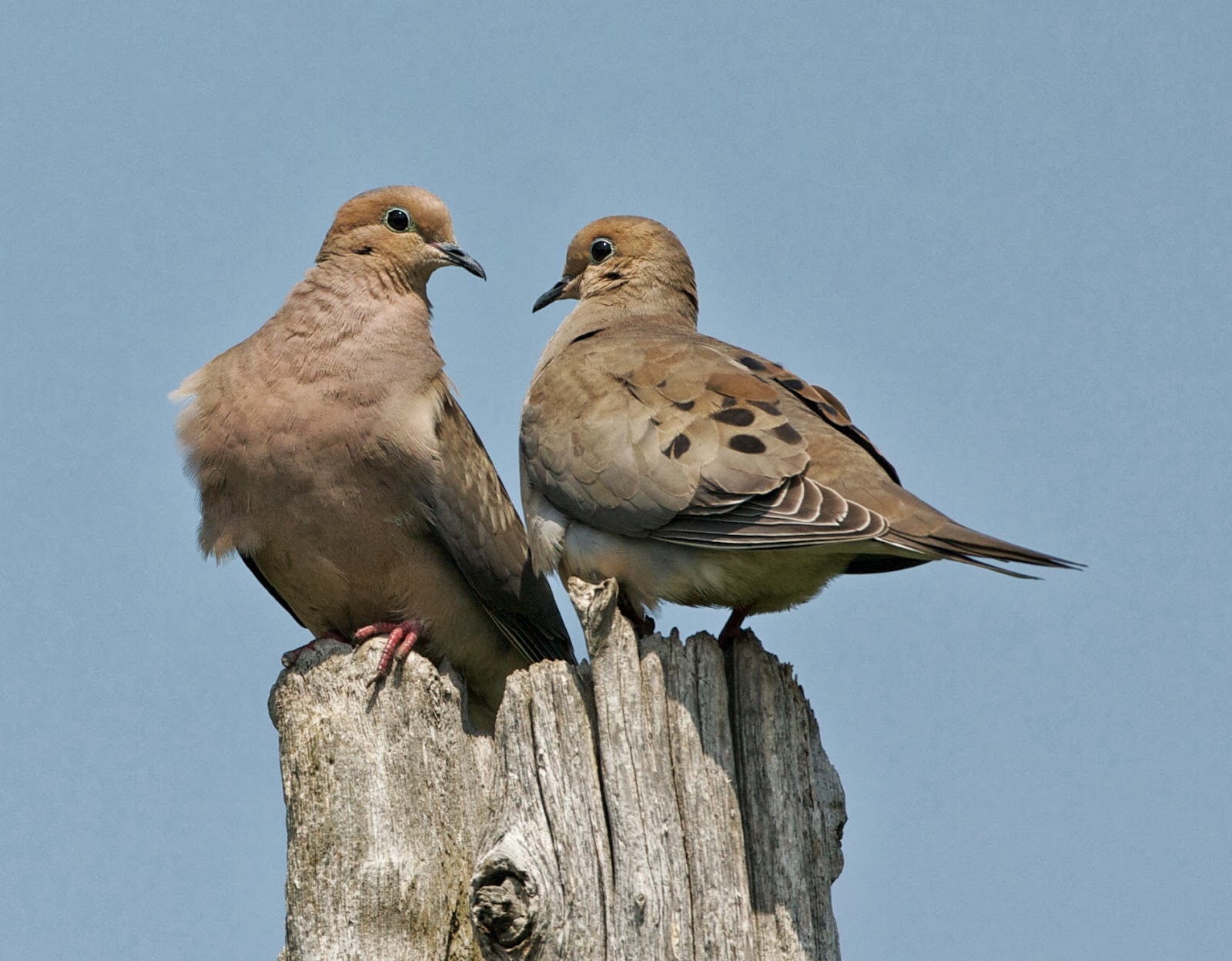
I know from experience that I’ll be castigated for daring to do what I am about to do, but I don’t give a damn.   What I am about to do is compare what I have written with something else that happened in early September; the federal and Ontario provincial governments – meaning Prime Minister Stephen Harper and Ontario Premier Kathleen Wynne, calmly decided to open a hunt for Mourning Doves in southwestern Ontario.

© Carol L. Edwards Photography
Of course there will invariably be those who snort that I’m putting animals ahead of people – an accusation animal protectionists frequently hear from the small-minded types who can’t conceive of enough compassion to go around.  Look, both children and doves are innocent and harmless, and both are capable of suffering.   Doves can live at most only a couple of decades…most die much sooner, and yes, they never develop the cognitive ability that makes us humans so proud of ourselves.   No dove will ever create great art, pen profound thoughts, develop a scientific theory or contribute to a just cause.  No dove will drop bombs, or sarin gas canisters, either, or trigger mass extinction or beat and starve little tots.

I get all that; honest.  But why should they therefore suffer or be killed for, what, sport?   Why should their lives be ended?   Why should they suffer?

Most of us don’t really want them to.   To us they are a garden bird, a familiar visitor to bird feeders whose gentle cooing in late March or early April is a placid portent of spring.  Occasionally they will nest in the yard, and often do so precariously, making a frail little platform of twigs where they lay two eggs, rarely more, and sometimes only one.   Because they nest from April to September, some will be nesting, with dependent young, while gunners legally search them out.

© Carol L. Edwards Photography
Mourning Doves eat weed seeds and other vegetal matter, and, in the nesting season, snails (the shells of snails provide the calcium used in forming their eggs), making them ecologically friendly friends of the gardener and the farmer, one might think.   They please us with their gentle beauty and many of us enjoy their softly modulated cooing and are delighted at the way the courting male puffs his neck out and bows in front of his lady, mating for life, which, for a dove, tends to be short, thanks to us.   So even those “masters of the universe” who think animals should only be valued to the degree they serve our needs, would, you would think, treasure these birds as the rest of us do.

Even if you think it is okay to kill them, given that they will eventually die (an odd viewpoint that I would not apply to anyone, but I’ve heard that argument made – kill it now so it won’t get a disease or be caught by a predator and suffer later) it is in the nature of dove shooting that many will be wounded.   They fly fast and shotguns fire handfuls of small, round pellets that spread out in a “pattern”, losing velocity and becoming ever more broadly spaced as they leave the gun’s barrel.   Ammunition manufacturers’ experiments show that on average, if six or more pellets hit a bird, it will likely be enough to kill or severely wound it.

Hunters prefer that the pellets are made of lead, a highly toxic substance whose weight increases the ballistic qualities of the pellets, giving them greater penetrating ability.   Now non-lead shot must be used, which, hunters claim, will increase wounding, but is not highly toxic.  Even now, years after lead shot was banned for waterfowl hunting, ducks, geese and swans still die horribly from lead poisoning when they mistake the pellets for gravel, called “grit”, which they swallow to aid digestion.

But why not our alternative…the one that you, I, and the vast majority of Ontarians choose: just don’t hunt them at all?   That way we don’t have to worry about increased wounding vs the horrors of lead poisoning, and guess what?   We haven’t had a legal Mourning Dove hunt since 1955, when such a hunt was held for one year and stopped in response to public opposition.   We don’t need one now.    The amount of meat on a dove’s breast, the part that is eaten by hunters, equals about half a wiener.   It’s not worth the shot gun shells needed to kill the birds.

Yes, yes, I understand what the pro-hunt people are saying…that there are enough doves around that those kinds of people who like to kill things can do so without wiping them out.  That applies to American Robins and Blue Jays, Sharp-shinned Hawks and Savannah Sparrows.   Is that the only concern?   If there is enough to kill, we should kill?   Surely we can do better.

And of course we should not forget that they said the same thing of the only other species of dove native to Ontario, at the time the most common of all our birds, the Passenger Pigeon.   Even so, they don’t make that argument any more about it, since it has been extinct for 99 years.  The last one known and documented, named Martha, dies in Cincinnati Zoo in 1914.   But the Passenger Pigeon lived in a time when we didn’t know better, and when cruel practices against people and animals abounded.    Do we not progress?

We do, and that could be why the gentle doves, symbols of peace in part because they are so utterly harmless, are now killed.   Too few hunters.   In Ontario sport hunters are in decline.   As Scott Petrie, Executive Director of Long Point Waterfowl and a staunch proponent of killing doves, has been quoted as saying, it will be good for young hunters.  “Because we have so many,” he said, referring to doves, “it’s a good opportunity for them to get out and shoot and practice their skills.”

And that brings me back to the reading I mentioned at the beginning…why are we cruel?   Part of it is through the mechanism of teaching.   Show me a boy who hunts and the statistical odds are that his father and grandfather hunted as well.    Hunters are dwindling…they like to kill and they want more to do so.  Usually they mount some arguments to justify the killing…the species is “too common”, or it is dangerous or that there is some conservation need, or at least for food.   But no…this little creature, the Mourning Dove, is to be killed for practice…practice in killing.   Don’t these people ever read the papers?   Are we not good enough at killing?

And it is that tiny minority who feels that way who have convinced the Harper government, in charge of Mourning Doves, that we need to teach kids to kill, to be better killers.   This tiny minority hopes we don’t notice or care…and why should we in a world full of horrors…the terrible things we do to each other are so ghastly and horrific; those are what should occupy us.  Ah, but stopping the dove hunt, is something we have done before.  I was just a little kid at the time…now it’s my turn, and yours, to do what we can do to reverse this stupid, ugly and cruel decision.

If you agree, write to:  

Prime Minister Stephen Harper
Office of the Prime Minister
80 Wellington Street
Ottawa, ON K1A 0A2

Phone:  1-800-62206232
TTY: 1-800-465-7735
Fax: 613 941-6900

E-Mail:  pm@pm.gc.ca

And to:

Premier Kathleen Wynne
Legislative Building
Queen’s Park
Toronto, ON M7A 1A1

Phone:  416 325 1941
TTY: 1-800-387-5559
Fax:  416 325 9895

E-Mail: premier@ontario.ca